
Aoru Optoelectronics Led the Drafting of the “White Paper on Off-Grid Wind-Solar-Storage Integrated Smart Sites,” and the First Expert Seminar Was Successfully Held
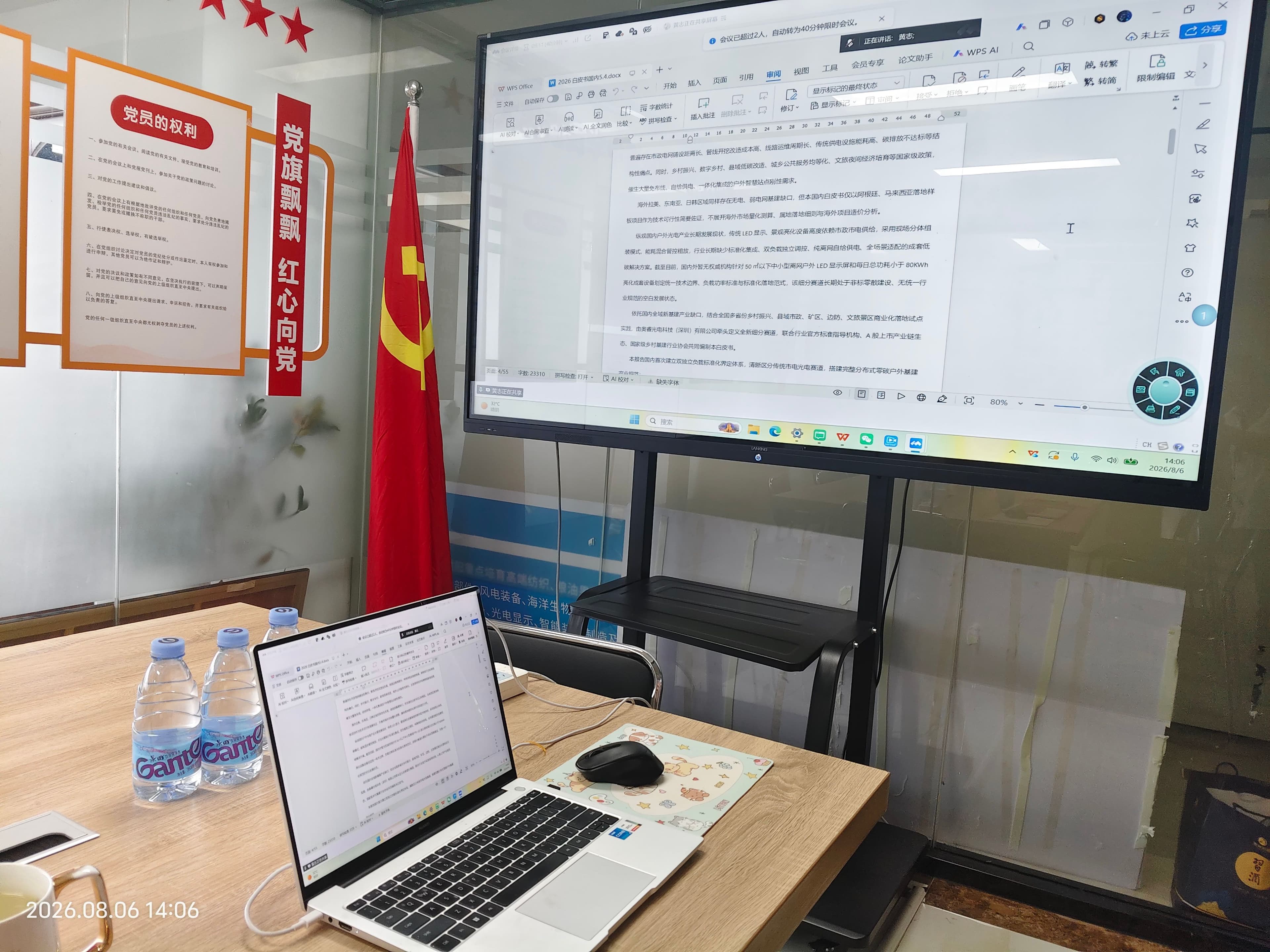
Today, the first online expert seminar on the *White Paper on Integrated Smart Low-Carbon Sites Combining Wind, Solar, Storage, and Display*, drafted under the leadership of Aori Optoelectronics Technology (Shenzhen) Co., Ltd., was successfully held. The seminar was chaired by Bao Enzhong, President of the Shenzhen Semiconductor Industry Development Promotion Association, and took place on schedule from 2:00 p.m. to 4:00 p.m. Andy Xiang, Chairman of Aorui Optoelectronics, and Vice President Huang Zhi represented the company’s core team and attended the entire event. Several authoritative university professors and senior industry experts from Shenzhen University, Tsinghua University Shenzhen Research Institute, South China University of Technology, Sun Yat-sen University, and the Shenzhen Institute of Quality and Metrology were invited to attend. Together, they provided guidance and recommendations on the white paper’s compilation framework, technical definitions, industrial framework, industry standards, and path to internationalization.
At the start of the meeting, Bao Enzhong, President of the Shenzhen Semiconductor Industry Development Promotion Association, introduced each member of the expert panel and highlighted the industry value of this white paper seminar. He noted that the integration of solar power, wind power, energy storage, and smart displays represents a brand-new niche in cross-industry innovation at the intersection of new energy and smart displays. Currently, the industry lacks a unified definition, technical framework, and standardization system; therefore, the compilation of this white paper marks a milestone for the industry’s standardized, systematic, and international development.
Subsequently, Andy Xiang, Chairman of Aori Optoelectronics, elaborated in detail on the rationale behind the white paper and the industry’s vision. He explained that Aori Optoelectronics has long been deeply involved in the implementation of multi-scenario applications—including off-grid photovoltaic storage, smart displays, and low-carbon outdoor lighting—and has accumulated a wealth of engineering data and project experience. By taking the lead in compiling this white paper, the company aims to systematize the technical logic of the sector, unify product definitions, standardize application criteria, and clarify the trajectory of industrial development. The goal is to establish an authoritative framework for the industry—one that is referenceable, reliable, and actionable—to drive the domestic integrated wind, solar, storage, display, and lighting industry toward high-quality development characterized by standardization, scalability, and globalization.
At the meeting, Huang Zhi, Vice President of Aori Optoelectronics, provided the expert panel with a comprehensive report on the white paper’s current overall structure, chapter layout, industry research content, technical framework, product logic, and case studies, fully showcasing the white paper’s current progress and future planning directions.
Multi-dimensional Calibration: A Comprehensive Upgrade to the Professional Standards of White Papers
The participating experts provided systematic, guiding, and standardized feedback on various aspects—including industry definitions, technical boundaries, topological architectures, data specifications, writing logic, the principle of neutrality, naming conventions, international benchmarks, and the macro-level industry landscape—thereby comprehensively enhancing the white paper’s authority and professionalism.
Professor Qian Keyuan, formerly of the Tsinghua Shenzhen Research Institute
Professor Qian systematically reviewed and authoritatively defined the core concepts, product and technical boundaries, and dual-load operating mechanisms of smart low-carbon sites, providing an in-depth analysis of the sector’s technological advantages and future market prospects. He also emphasized that all industrial data, technical parameters, and industry references in the white paper must be clearly sourced, properly annotated, and verifiable, to ensure the document’s rigor, professionalism, authority, and verifiability.
Professor Yu Jianhua, formerly of Shenzhen University
Professor Yu suggested that the white paper should maintain a macroprudential, objective, and neutral tone in its industry analysis and further precisely define the boundaries of the “wind-solar-storage-display” integrated segment. He recommended refining the system topology diagram, technical framework diagram, and application logic diagram, as well as optimizing the overall chapter structure, to make the complex multi-energy coupling technology system more accessible, clear, systematic, and visual, thereby facilitating its adoption within the industry and academic citation.
Professor Wen Shangsheng, formerly of South China University of Technology
Professor Wen emphasized that the white paper must adhere to the principles of industry neutrality, objectivity, and fairness in its compilation, and establish a scientific writing logic that follows the sequence of “standard definitions first, data citations second, and case studies third.” He provided clear guidance: content covered by existing national, industry, or international standards must be cited directly in compliance with those standards; for innovative technical parameters for which no unified industry standard currently exists, laboratory test data, system simulation data, and field test data may be used as authoritative references to ensure the scientific rigor and accuracy of the content.
Dr. Cai Chun, formerly of the Shenzhen Institute of Quality and Metrology Testing
Dr. Cai offered key recommendations for standardization and internationalization: He suggested officially renaming the white paper to *White Paper on Integrated Smart Sites for Off-Grid Wind, Solar, and Storage Systems*. This naming convention aligns with the World Bank’s general standards for off-grid lighting and off-grid renewable energy, making it fully compatible with the global classification system for off-grid renewable energy products. Consequently, companies’ products can integrate with the ICE certification system, be smoothly included in the World Bank’s off-grid product procurement catalog, and significantly enhance their international credibility and eligibility for overseas projects. At the same time, Dr. Cai systematically standardized the white paper’s academic framework, chapter structure, data index, and reference formatting, ensuring full alignment with authoritative industry white paper compilation standards.
Professor Qi Shan, formerly of Sun Yat-sen University
Professor Qi recommends that the overall structure of the document strictly follow the professional narrative logic of addressing macro-level industries first and micro-level technologies second. He suggests further expanding on the macro-level context, policy trends, market size, and competitive landscape of the global and domestic new energy industries to elevate the white paper’s industry standing and enhance its guidance and leadership within the sector.
With the finalization of the iteration plan and the conclusion of the workshop later this month, Bao Enzhong, President of the Shenzhen Semiconductor Industry Development Promotion Association, delivered closing remarks and outlined the next steps. He highly commended Aori Optoelectronics for its commitment to deepening its expertise in niche markets and taking the lead in establishing industry standards. He urged the team to fully incorporate and implement each of the experts’ recommendations, refine the content framework from the perspectives of the entire industry, the broader sector, and the global market, and ensure that the white paper embodies industry representativeness, technical authority, and market guidance. It was formally agreed at the meeting that a fully revised and optimized version of the white paper would be submitted by the end of this month, after which the Association will organize a second round of集中 final review and evaluation by experts. Finally, Andy Xiang, Chairman of Aori Optoelectronics, expressed his sincere gratitude to the experts for their meticulous guidance and authoritative input, as well as to the Shenzhen Semiconductor Industry Development Promotion Association for its platform support. He stated that Aori Optoelectronics will move full steam ahead with iterating and refining the white paper, strictly adhering to the principles of professionalism, rigor, neutrality, and objectivity in its compilation. The company is fully committed to creating China’s first authoritative industry white paper on integrated off-grid wind-solar-storage-display solutions, providing the industry with clear technical standards, application frameworks, and development guidelines. This effort aims to support the international standardization of China’s original new energy display technologies and lead the global development of the low-carbon smart site industry.
Organizing Body for This Conference: Shenzhen Semiconductor Industry Development Promotion Association; President: Bao Enzhong; Participating Companies: • Aori Optoelectronics Technology (Shenzhen) Co., Ltd.; Chairman: Xiang Hongfu (Andy Xiang); • Aori Optoelectronics Technology (Shenzhen) Co., Ltd.; Vice President: Huang Zhi; Invited Panel of Leading Experts: • Professor Qian Keyuan, formerly of Tsinghua University Shenzhen Research Institute • Professor Yu Jianhua, formerly of Shenzhen University • Professor Wen Shangsheng, formerly of South China University of Technology • Dr. Cai Chun, formerly of Shenzhen Institute of Quality and Metrology • Lecturer Qi Shan, formerly of Sun Yat-sen University